Microinverters vs String Inverters: Which Fits Your Roof?
Compare microinverters, string inverters, and optimizers by shade, roof complexity, monitoring, cost, serviceability, and battery compatibility.
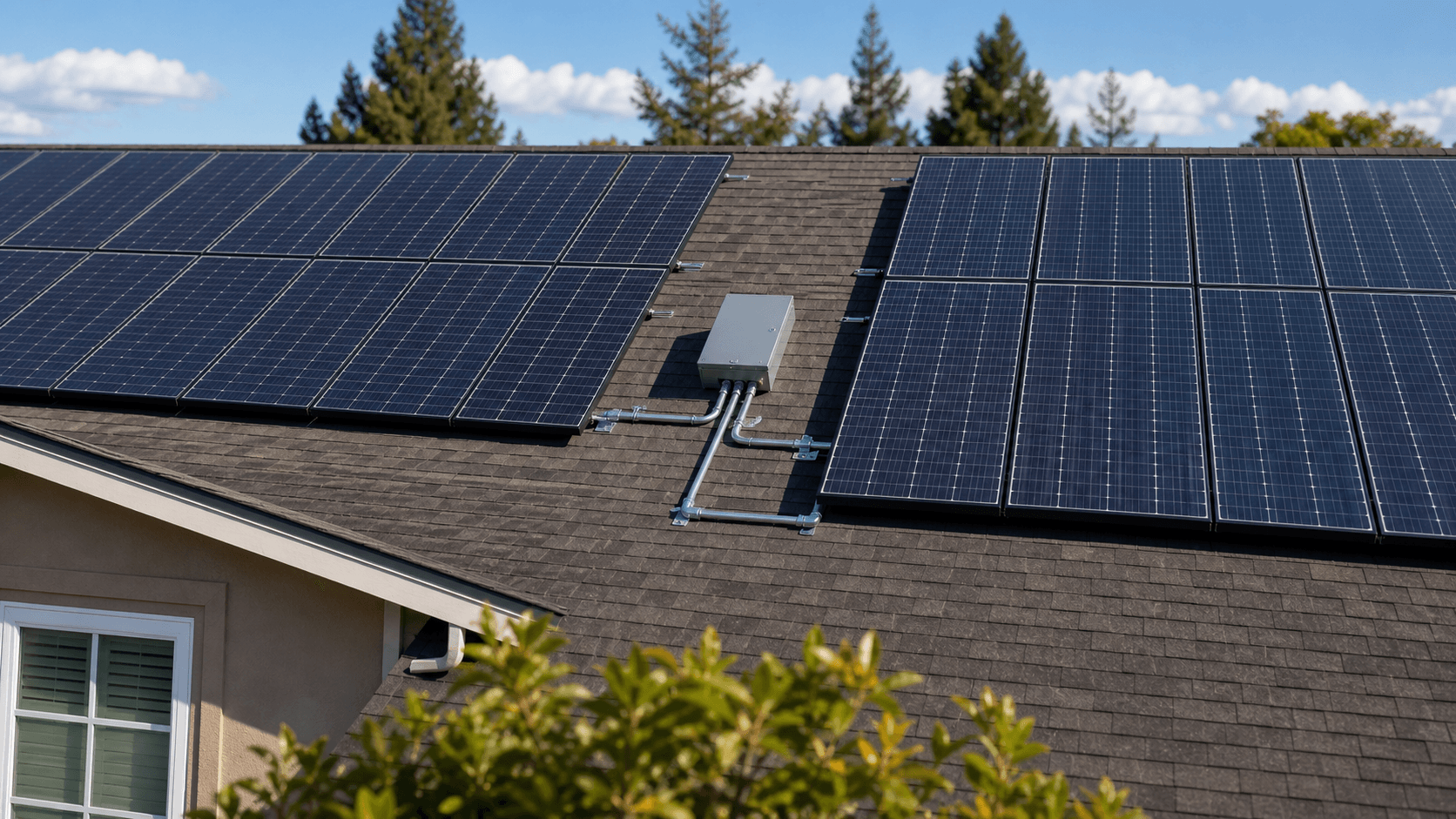
Quick verdict
Microinverters often make more sense on complex or partly shaded roofs where module-level behavior and monitoring matter. String inverters often make more sense on simpler roofs when lower equipment cost and centralized serviceability are the priority.
Power optimizers sit between those two options. They can improve module-level behavior while still using a central inverter design.
Before choosing equipment, estimate the system with the Panel Estimator and review the deeper equipment context in the Solar Inverters Guide.
Roof scenario matrix
| Roof or design condition | Often worth reviewing | Why it matters |
|---|---|---|
| Simple south-facing roof with little shade | String inverter | A simple array may not need panel-level electronics. |
| Multiple roof planes or orientations | Microinverters or optimizers | Panel groups may produce differently across the day. |
| Partial shade from trees, vents, or dormers | Microinverters or optimizers | Module-level behavior can reduce the impact of uneven production. |
| Strong panel-level monitoring preference | Microinverters or optimizers | Homeowners can see more detailed module-level performance. |
| Centralized service preference | String inverter | Main equipment may be easier to access from one location. |
How string inverters work
A string inverter groups multiple panels into one or more strings and converts their DC power to AC in a central location. This can simplify the equipment layout and keep the main inverter accessible for service.
String inverters can be a strong fit when the roof is simple, shade is limited, and the quote clearly explains expected production.
How microinverters work
Microinverters sit at the panel level, so each module converts DC to AC individually. That can help when roof planes differ, shade is uneven, or homeowners want more panel-level visibility.
The tradeoff is that equipment is distributed across the array, so service access and total installed cost should be compared carefully.
Where power optimizers fit
Optimizers are not the same as microinverters, but they are often part of the same conversation. They can improve module-level behavior while still relying on a central inverter architecture.
If a proposal recommends optimizers, ask what roof condition they are solving and how the expected production changes compared with a simpler design.
Shade, monitoring, and serviceability
This decision usually comes down to roof conditions and service priorities. Avoid choosing based only on a sales claim that one architecture is always better.
- simple roof, low shade: a string inverter may be enough
- multiple roof planes: microinverters or optimizers may fit better
- strong panel-level monitoring preference: microinverters or optimizers deserve review
- centralized equipment preference: a string inverter may be easier to service
If shade is part of the decision, also read Roof Shading and Solar Panels and the glossary entry for inverter clipping.
Battery compatibility questions
Battery planning can change the best inverter path. Not every inverter architecture interacts with storage in the same way, and battery compatibility can depend on AC coupling, DC coupling, backup-panel design, manufacturer ecosystem, and installer configuration.
- Can this inverter path support the battery you may want later?
- Would adding storage require replacing major equipment?
- Is backup designed for the whole home or selected critical loads?
- How does the inverter design affect monitoring and service access?
If storage may be added later, compare this equipment decision with the Solar Batteries Guide before signing a proposal.
Questions to ask before choosing
- What roof condition makes this inverter architecture the better fit?
- How does the proposal estimate annual kWh production?
- What happens if one panel is shaded or underperforms?
- What monitoring detail will I actually see as the homeowner?
- How would service work if an inverter component fails?
Bottom line
The best inverter choice depends on roof complexity, shade pattern, monitoring goals, service preferences, and future battery plans. Compare the roof layout and production assumptions, not just the sales pitch.
Evidence
Sources and methodology
SolarPel treats inverter choice as a roof-design and serviceability decision. The comparison emphasizes roof layout, shade, monitoring, service access, battery compatibility, and visible proposal assumptions rather than universal equipment claims.
decision table
Includes a roof-scenario matrix for matching inverter options to homeowner conditions.
mistake warning
Warns readers not to choose inverter architecture from generic sales claims without checking roof layout and production assumptions.
calculator example
Routes readers to the Panel Estimator before comparing quote equipment.
Article FAQ
Common questions
Are microinverters better than string inverters?
Not always. Microinverters can be better for complex or partly shaded roofs, while string inverters can be a strong fit for simple, low-shade roofs.
Are microinverters better for shade?
They can help when shade affects panels unevenly, but the roof layout, shade timing, and full system design still matter.
Are string inverters cheaper?
String inverters are often lower cost at the equipment level, but total installed cost depends on the full proposal, roof layout, electrical work, and monitoring requirements.
Do inverters affect battery compatibility?
Yes. The inverter architecture can affect how storage is added, whether backup is AC- or DC-coupled, and how the backup system is configured.
Written by
Firoz Ahmed
SolarPel Editorial Lead
Firoz Ahmed writes SolarPel's solar calculators, planning guides, and technical explainers with a focus on practical home-energy decisions, transparent assumptions, and source-backed solar research.