Solar Battery Buying Guide: Backup, Capacity, and Quote Checks
Compare solar batteries by backup goal, usable capacity, kW output, critical loads, inverter compatibility, warranty terms, and quote assumptions.
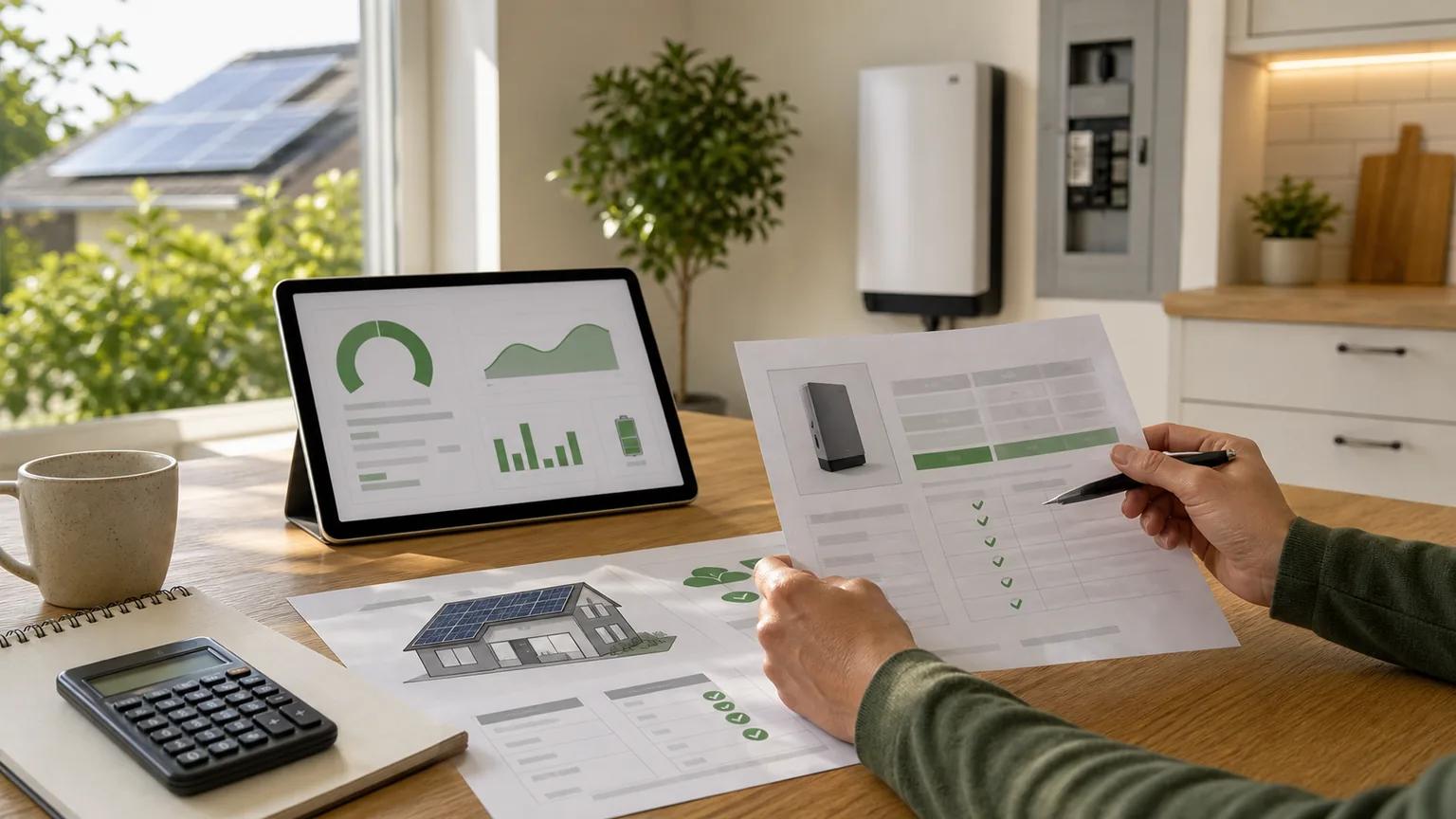
Quick answer
A good solar battery purchase starts with the job you need the battery to do. Backup for a refrigerator, lights, internet, and a few outlets is a different project from whole-home backup, time-of-use savings, or pairing storage with weak export credits.
Before comparing brands, separate three questions: how much usable energy you need, how much power the battery/inverter can deliver at once, and whether the system fits your solar inverter, electrical panel, utility rules, and backup-load plan.
Start with the use case, not the product name
Battery marketing often focuses on cabinet size and headline capacity. Homeowners should start with the purpose. A battery that is excellent for short outage coverage may not be the right choice for long backup duration, high surge loads, or a complicated retrofit.
- Critical-load backup: supports selected circuits such as refrigeration, lights, internet, medical devices, and outlets.
- Whole-home backup: attempts to support most or all loads, usually with more capacity, more power output, and careful load management.
- Time-of-use shifting: stores cheaper solar or grid energy to use during expensive rate periods.
- Low export-credit strategy: uses more solar onsite when exported kWh are worth less than imported kWh.
If backup is the main goal, start with the Battery Sizer before comparing quotes.
Capacity kWh and power kW are different
Battery capacity, measured in kWh, tells you how much energy can be stored. Battery power output, measured in kW, tells you how much load can be served at the same time. Both matter.
- Capacity answers: how long can selected loads run?
- Power output answers: can the battery run those loads at the same time?
- Surge power matters for motors, pumps, compressors, and some appliances when they start.
A battery with enough kWh may still fail the use case if inverter output is too low for simultaneous or surge loads. This is why a real backup design should list loads, running watts, startup surge, and hours of use.
The basic battery sizing formula
Use a critical-load workflow first:
- Daily critical-load kWh = sum of each load's watts x hours used / 1000.
- Required usable battery kWh = daily critical-load kWh x backup days.
- Required nominal battery kWh = usable battery kWh / depth of discharge / inverter efficiency.
This is a planning estimate. Actual backup runtime depends on load behavior, usable capacity limits, temperature, inverter efficiency, reserve settings, solar recharging during the outage, and battery age.
For a practical example, read solar battery size guide for critical home loads.
Decide between critical-load and whole-home backup
Critical-load backup is often simpler and more predictable because it limits the battery to the circuits that matter most. Whole-home backup can be more comfortable, but it usually needs more capacity, higher inverter output, smart load control, or multiple batteries.
- Critical-load panels can keep essential circuits separate and easier to model.
- Whole-home backup should account for HVAC, electric water heating, well pumps, ovens, dryers, EV charging, and other large loads.
- Some large loads may need load shedding or a dedicated backup plan instead of assuming everything runs normally.
If an installer says a battery will power the whole home, ask which loads are included, which are excluded, and what happens when several large loads start together.
Check solar and inverter compatibility
Battery compatibility depends on more than the battery cabinet. The inverter strategy, existing solar design, backup panel, utility interconnection, monitoring, and installation location can all affect the quote.
- Hybrid inverter systems can be designed for storage from the start.
- AC-coupled batteries can work well as retrofits, but the design still needs careful compatibility review.
- Microinverter, optimizer, and string-inverter systems may each have different storage paths.
Use the solar inverters guide to understand why inverter choice matters before approving a battery quote.
Understand usable capacity and reserve settings
The battery nameplate capacity may not equal usable capacity. Depth of discharge, backup reserve, battery management settings, and warranty requirements can reduce the energy available for daily use or outage coverage.
- Ask for usable kWh, not just nameplate kWh.
- Ask what reserve percentage is assumed for backup mode.
- Ask whether warranty terms depend on cycling limits, throughput, temperature, or installation conditions.
- Ask how much capacity is expected to remain near the end of the warranty period.
Evaluate battery value without forcing ROI
Battery value is not always captured by a simple payback number. Storage may be worth it for outage resilience, medical or work-from-home needs, time-of-use rates, or weak export credits. It may not be financially attractive if outages are rare, export credits are strong, or the battery is oversized.
Separate solar-only economics from solar-plus-battery economics with the solar ROI guide. That keeps resilience value from being hidden inside a generic payback claim.
- Compare solar-only cost and savings against solar-plus-battery cost and savings.
- Value resilience separately if backup comfort is the main reason for buying storage.
- Use conservative assumptions for time-of-use arbitrage and export-credit savings.
Battery quote checklist
A good quote should show the storage design clearly enough that you can compare it against another installer proposal. If a quote only lists a battery brand and total price, ask for the missing details.
- Battery model, quantity, nameplate capacity, and usable capacity.
- Continuous power output, peak/surge output, and supported backup loads.
- Inverter or gateway equipment and whether the system is AC-coupled or DC-coupled.
- Backup panel or load-control scope, including excluded large loads.
- Warranty term, capacity retention, labor coverage, and monitoring requirements.
- Installation location, temperature limits, clearances, and permitting scope.
- Solar recharging behavior during grid outages.
Common battery buying mistakes
Most bad battery decisions come from buying capacity before defining the load plan. The right quote should make the backup goal visible and testable.
- Assuming one battery can power every load in the house.
- Comparing nameplate kWh while ignoring usable capacity.
- Ignoring kW output and surge loads.
- Forgetting backup reserve settings and inverter efficiency.
- Adding a battery to improve ROI without modeling solar-only economics first.
- Not checking inverter, monitoring, warranty, or retrofit compatibility.
Recommended path through the battery cluster
Use this page as the main battery buying hub. It should help you decide whether storage is worth deeper review before comparing brands, quotes, or installer claims.
First, size essential loads with the Battery Sizer. Then read the solar batteries guide for core storage terms and the solar inverters guide for compatibility questions.
If you are still planning the solar array itself, use the solar system sizing guide before finalizing battery size. For installer quote context, review solar inverter types for homeowners.
Bottom line
The best solar battery is not the largest cabinet or the most familiar brand name. It is the storage design that fits the loads you care about, delivers enough power at the right time, integrates cleanly with your solar and electrical system, and has quote assumptions you can verify.
Evidence
Sources and methodology
SolarPel battery buying guidance starts with the homeowner's backup or rate-management goal, then evaluates usable capacity, power output, surge loads, depth of discharge, inverter efficiency, reserve settings, solar recharging, and compatibility. It is intended for planning and quote review, not as electrical design, code, safety, tax, warranty, or product-selection advice.
formula
Explains usable battery kWh, nominal battery kWh, depth of discharge, inverter efficiency, and power-output checks in one buyer workflow.
scenario comparison
Separates critical-load backup, whole-home backup, time-of-use shifting, and low export-credit use cases before comparing products.
mistake warning
Warns against buying based only on battery brand or nameplate kWh without checking usable capacity, kW output, surge loads, and compatibility.
methodology
Connects battery buying decisions to the Battery Sizer, inverter guide, system sizing hub, and ROI workflow so storage is not evaluated in isolation.
Article FAQ
Common questions
What should I look for when buying a solar battery?
Start with usable capacity, continuous power output, surge capability, backup-load plan, inverter compatibility, warranty terms, installation location, and whether the battery supports your actual goal: outage backup, time-of-use shifting, or low export-credit strategy.
How many kWh of battery storage do I need?
Estimate the daily kWh of the loads you want to back up, multiply by the number of backup days, then adjust for usable capacity, depth of discharge, inverter efficiency, and reserve settings. Whole-home backup usually needs much more capacity than critical-load backup.
Can one solar battery power a whole house?
Sometimes, but not always. It depends on the battery capacity, inverter output, load-control setup, large appliances, surge loads, and how long you expect backup to last. Ask the installer exactly which loads are included and excluded.
Does a solar battery improve payback?
It depends. Batteries can add value for outages, time-of-use rates, or low export credits, but they also add cost. Compare solar-only economics against solar-plus-battery economics before assuming storage improves payback.
What is the difference between battery kWh and kW?
kWh measures stored energy, which affects runtime. kW measures power output, which affects how much load can run at once. A good battery design must satisfy both runtime and simultaneous-load requirements.
Written by
Firoz Ahmed
SolarPel Editorial Lead
Firoz Ahmed writes SolarPel's solar calculators, planning guides, and technical explainers with a focus on practical home-energy decisions, transparent assumptions, and source-backed solar research.