Solar Batteries Guide: Capacity, Backup Loads, and Storage Value
Understand solar battery capacity, power output, critical-load backup, whole-home backup, inverter compatibility, and battery economics.
Quick answer
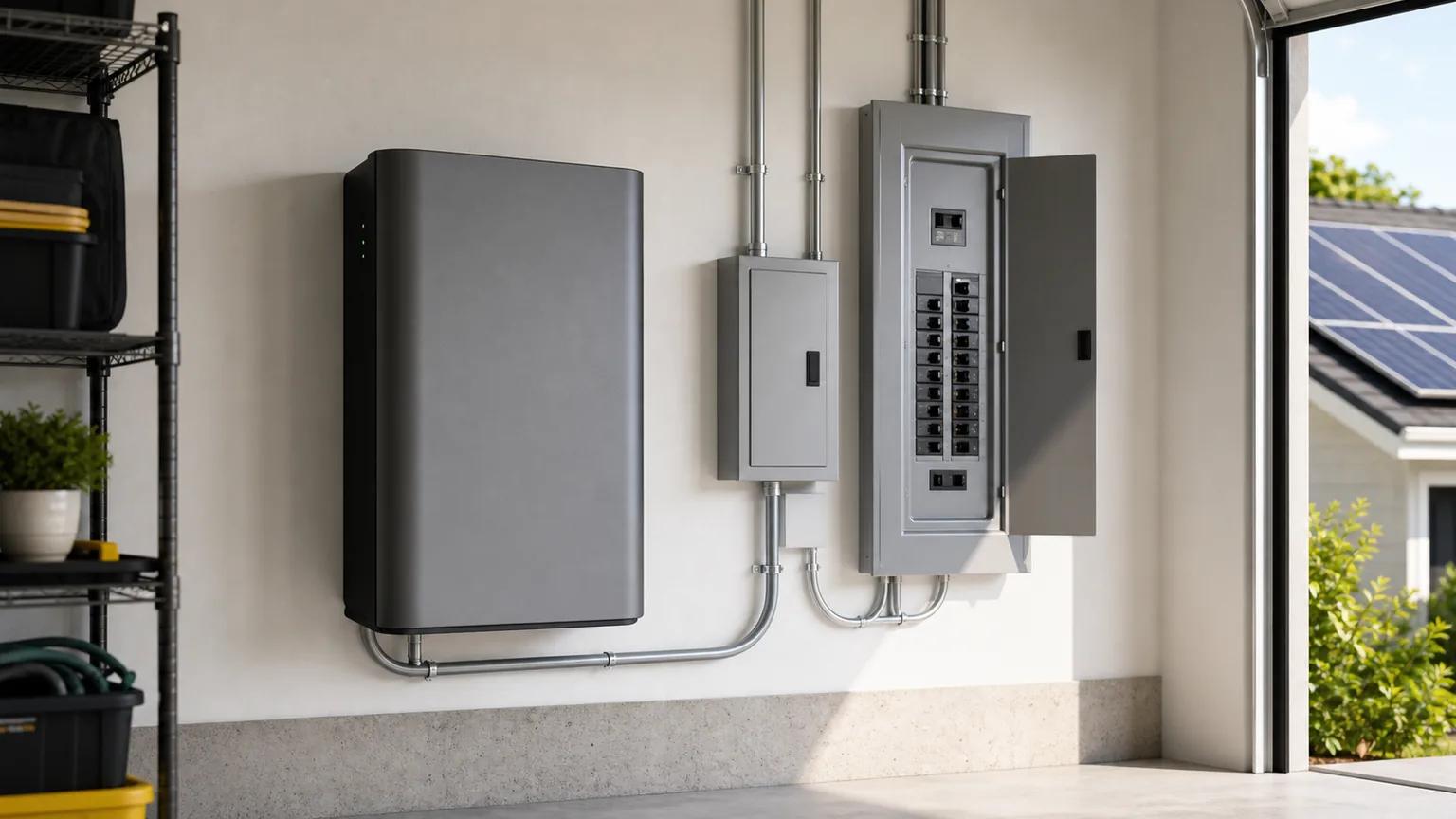
Solar batteries store energy for backup, time-of-use savings, or better self-consumption. The key planning distinction is capacity in kWh versus power output in kW: runtime and simultaneous-load capability are different questions.
A useful battery plan starts with critical loads, backup duration, usable capacity, inverter efficiency, depth of discharge, solar recharging, and whether the home needs critical-load backup or whole-home backup.
Capacity kWh vs power kW
Capacity tells you how much energy is stored. Power tells you how much load can run at the same time. A battery can have enough stored energy but still fail if it cannot deliver enough power for simultaneous or surge loads.
- kWh affects backup runtime.
- kW affects what can run at once.
- Surge power matters for motors, compressors, pumps, and some appliances.
For buyer-level checks, use the solar battery buying guide.
The basic battery sizing workflow
Start with the loads that matter most during an outage.
- Daily critical-load kWh = watts x hours / 1000 for each load.
- Required usable kWh = daily critical-load kWh x backup days.
- Required nominal kWh = usable kWh / depth of discharge / inverter efficiency.
- Power-output check: battery inverter kW must exceed simultaneous load and surge needs.
Run the first-pass estimate in the Battery Sizer.
Critical loads vs whole-home backup
Critical-load backup usually powers selected circuits such as refrigeration, lights, internet, medical devices, and outlets. Whole-home backup tries to cover more of the home, but it often needs more batteries, load controls, and careful design.
- Critical-load panels make runtime easier to predict.
- Whole-home backup can be expensive if HVAC, water heating, cooking, well pumps, or EV charging are included.
- Large loads may need load shedding instead of continuous backup.
For a practical load example, read solar battery size guide for critical home loads.
Solar recharging during outages
Not every solar system can recharge a battery during a grid outage without the right inverter, gateway, and backup design. Ask how the system behaves when the grid is down.
- Can solar recharge the battery during an outage?
- What loads can run while solar is charging?
- What happens when the battery reaches reserve?
- Does the system need a critical-load panel or smart load control?
Battery economics
Battery economics depend on outage value, export-credit rules, time-of-use rates, and system cost. A battery can be valuable even when simple payback is long, but that resilience value should be stated separately.
Compare solar-only and solar-plus-battery economics with the Solar ROI guide and Solar ROI Calculator.
- Do not assume a battery improves payback automatically.
- Value backup comfort separately from bill savings.
- Weak export credits can make self-consumption more important.
Compatibility and warranty checks
Battery storage depends on inverter compatibility, monitoring, installation location, clearances, temperature limits, and warranty terms. The quote should explain those items clearly.
Use the solar inverters guide to understand storage compatibility questions.
- Ask for usable capacity and reserve settings.
- Ask about capacity retention at the end of the warranty.
- Ask whether labor is covered for warranty service.
- Ask what cycling, throughput, or temperature limits apply.
Bottom line
Solar batteries are best evaluated by the job they need to do. Define the loads, runtime, power output, compatibility, and value of backup first; then compare products and quotes.
Evidence
Sources and methodology
SolarPel battery guidance separates usable capacity, power output, surge loads, depth of discharge, inverter efficiency, critical-load planning, solar recharging, and economic value. It is planning guidance, not electrical design or product-selection advice.
capacity vs power
Makes kWh capacity and kW power output a central battery-evaluation distinction.
formula
Connects battery capacity to daily critical-load kWh, backup days, depth of discharge, and inverter efficiency.
methodology
Connects batteries to buying checks, inverter compatibility, system sizing, and ROI.
Article FAQ
Common questions
What does solar battery capacity mean?
Capacity is stored energy, measured in kWh. It affects how long selected loads can run, but usable capacity may be lower than nameplate capacity.
What does battery power output mean?
Power output is measured in kW and affects how much load can run at once. Surge power also matters for motors, pumps, and compressors.
Is critical-load backup better than whole-home backup?
It depends on the goal. Critical-load backup is often simpler and more predictable; whole-home backup usually needs more capacity, power output, and load management.
Can solar recharge batteries during an outage?
Only if the solar, inverter, battery, gateway, and backup design support it. Ask the installer exactly how solar recharging works during grid outages.
Do batteries improve solar ROI?
Sometimes, but not always. Batteries add cost and may add value through backup, time-of-use savings, or low export-credit strategy. Compare solar-only and solar-plus-battery economics separately.
Written by
Firoz Ahmed
SolarPel Editorial Lead
Firoz Ahmed writes SolarPel's solar calculators, planning guides, and technical explainers with a focus on practical home-energy decisions, transparent assumptions, and source-backed solar research.