Solar System Sizing Guide: Estimate Panels, kW, and Roof Fit
Learn how to size a home solar system from monthly kWh use, peak sun hours, roof constraints, panel wattage, shading, future loads, and quote assumptions.
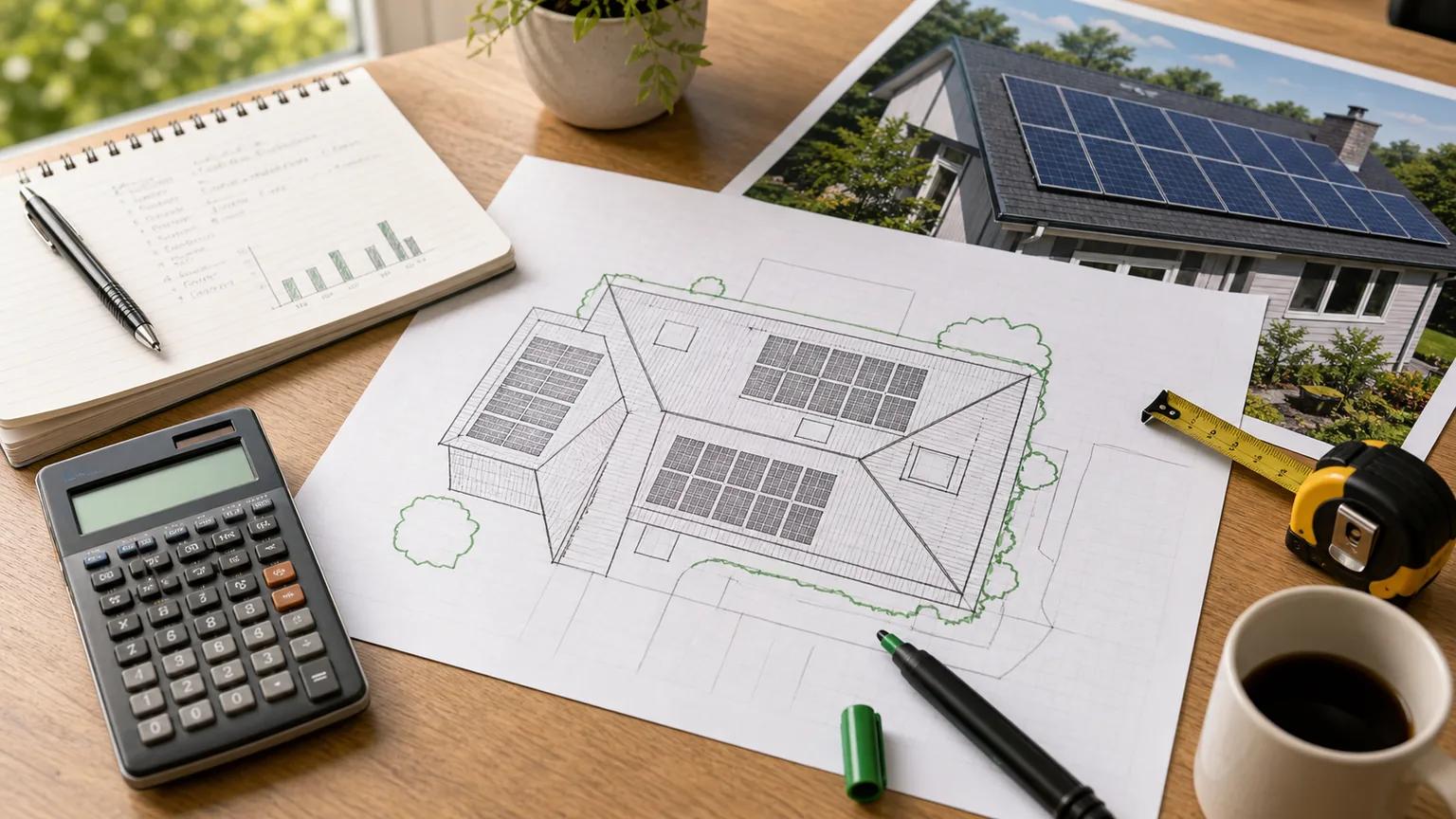
Quick answer
A practical home solar system size starts with electricity use, not square footage. Convert monthly kWh into daily kWh, divide by local peak sun hours, then adjust for real-world losses before estimating panel count.
That first number is only a planning estimate. A quote-ready size also checks roof area, shading, panel wattage, inverter limits, future loads, battery goals, utility rules, and whether the homeowner wants maximum offset or a smaller budget-controlled system.
The core solar system sizing formula
Use this workflow before comparing installer proposals:
- Daily kWh use = monthly kWh use / 30.
- Estimated solar array size in kW = daily kWh use / peak sun hours x loss factor.
- Estimated panel count = array size in watts / panel wattage.
The loss factor accounts for real-world issues such as heat, inverter conversion, wiring, soiling, panel mismatch, imperfect orientation, and modest system degradation. SolarPel uses this as a planning factor, not as a replacement for an installer site survey or engineering design.
If you do not know your monthly usage yet, start with the Energy Consumption Calculator. Then use the Panel Estimator to translate kWh use into a first-pass system size and panel count.
Step 1: Start with annual or monthly kWh
The most reliable sizing input is your actual utility usage history. One month can be misleading because heating, cooling, visitors, EV charging, and seasonal habits can swing electricity use sharply.
- Use 12 months of utility bills when possible.
- If you only have one bill, note whether it is a high, low, or normal usage month.
- Separate future loads such as an EV, heat pump, pool pump, workshop, or home addition.
- Do a basic home energy audit before sizing if usage seems unusually high.
For a practical pre-solar checklist, read home energy audit before solar before relying on a large system quote.
Step 2: Use peak sun hours, not daylight hours
Peak sun hours are not the same as sunrise-to-sunset daylight. They estimate the equivalent hours of strong solar energy available for production. A sunny five peak-sun-hour location can often support a smaller array than a cloudy three peak-sun-hour location for the same monthly kWh target.
- Use local solar-resource data where possible, not a national average.
- Model conservative output if the roof has shade, poor orientation, or complex roof planes.
- Do not assume every daylight hour produces full panel output.
Step 3: Decide what percent of the bill you want to offset
A 100 percent offset is not always the best target. Some homeowners want maximum annual production. Others prefer a smaller array because roof area is limited, export credits are weak, budget is tight, or future battery strategy matters.
- Full-offset sizing can make sense when export credits are strong and roof space is available.
- Partial-offset sizing can make sense when exported energy is paid at a lower rate.
- A battery-focused design may prioritize evening usage and critical loads instead of maximum annual kWh.
After the first sizing pass, test the financial result with the solar ROI guide and the Solar ROI Calculator.
Step 4: Check roof space and panel layout
Panel count is not just a math result. It also has to fit on usable roof space with safe access pathways, fire setbacks, roof obstructions, roof age, orientation, and structural limits.
- South-facing roof planes are often useful, but east and west planes can also be valuable depending on utility rates and usage timing.
- Dormers, vents, skylights, chimneys, hips, valleys, and setbacks can reduce usable panel area.
- A slightly smaller clean layout can be better than forcing panels into poor locations.
Use the solar panels guide for panel wattage, roof fit, warranties, degradation, and quote-comparison questions.
Step 5: Adjust for shading and real production loss
Shading is one of the fastest ways to turn a good-looking system size into disappointing production. Trees, neighboring buildings, chimneys, roof geometry, and seasonal sun angles can all reduce output.
- Ask whether the proposal includes a shade analysis, not just a satellite image.
- Check morning, midday, and afternoon shade patterns if the roof has nearby trees or obstructions.
- Use conservative production assumptions when shade is uncertain.
For more detail, read roof shading and solar production losses.
Step 6: Match inverter strategy to the array
The inverter converts solar-panel DC power into usable AC power. Inverter choice can affect shade tolerance, monitoring, clipping, battery compatibility, serviceability, and future expansion.
- String inverters can work well on simple, low-shade roofs.
- Microinverters or optimizers may help when roof planes, shading, or panel-level monitoring matter.
- Battery-ready or hybrid inverter choices should be reviewed before adding storage later.
Use the solar inverters guide when an installer quote lists inverter equipment you do not recognize.
Step 7: Account for future loads before finalizing
A system sized only for last year's bill may feel undersized after an EV, heat pump, induction range, electric water heater, or home office load is added. Future-load planning should be explicit, not guessed.
- Estimate extra monthly kWh for planned EV charging or electrification upgrades.
- Decide whether to install a larger array now or leave space for expansion later.
- Ask how future expansion affects inverter capacity, panel availability, monitoring, and permitting.
A simple sizing example
Suppose a home uses 900 kWh per month. That is about 30 kWh per day. In a location with 5 peak sun hours, a simple no-loss screen is 6 kW. After adding a planning loss factor, the homeowner may compare a system around 7 to 8 kW before roof constraints and quote details are reviewed.
- 900 kWh per month / 30 = 30 kWh per day.
- 30 kWh per day / 5 peak sun hours = 6 kW before losses.
- 6 kW x 1.2 to 1.3 planning factor = about 7.2 to 7.8 kW for comparison.
This example is not a guarantee. It simply shows how usage, sunlight, and real-world losses combine before panel count is calculated.
Common sizing mistakes
The biggest sizing errors come from using the wrong starting input or ignoring the physical site. A large system on paper can still be a weak design if roof fit, shade, export credits, or future goals are misunderstood.
- Sizing from home square footage instead of electricity use.
- Using one unusually high or low bill as the full-year baseline.
- Ignoring roof shading, roof age, or panel placement constraints.
- Assuming 100 percent bill offset is always financially best.
- Forgetting EV charging, heat pumps, or battery goals.
- Comparing quotes with different production assumptions as if they are equal.
Recommended path through the system-sizing cluster
Use this page as the main system-sizing hub. It should help you understand how many panels may be needed before you evaluate costs, payback, battery storage, or installer proposals.
Start with usage in the Energy Consumption Calculator, estimate panel count with the Panel Estimator, then review equipment assumptions in the solar panels guide and solar inverters guide.
For practical examples, read how many solar panels your home needs, home energy audit before solar, and roof shading and solar production losses.
Bottom line
A good solar system size is not the biggest number a roof can hold. It is the size that matches usage, sunlight, roof constraints, utility rules, future loads, and financial goals. Use the sizing estimate as a decision screen, then compare installer proposals against the assumptions behind it.
Evidence
Sources and methodology
SolarPel system-sizing guidance starts with electricity usage, converts monthly kWh into daily kWh, adjusts for local peak sun hours and real-world production losses, then checks roof layout, shading, inverter strategy, future loads, and financial goals. It is intended for planning and quote review, not as engineering, permitting, electrical, or installer design advice.
formula
Shows the usage-to-system-size-to-panel-count workflow and explains why a planning loss factor is needed.
scenario comparison
Separates current usage, future loads, roof constraints, and target bill offset so users can compare several quote-ready system sizes.
mistake warning
Warns against sizing solar from square footage, one abnormal bill, or a roof-only panel count without checking utility and financial assumptions.
methodology
Connects the sizing guide to the Energy Consumption Calculator, Panel Estimator, equipment guides, shading article, and ROI workflow.
Article FAQ
Common questions
How do I estimate what size solar system I need?
Start with 12 months of electricity use if available. Divide monthly kWh by 30 to estimate daily use, divide by local peak sun hours, then add a real-world loss factor before estimating panel count.
Is home square footage enough to size solar panels?
No. Square footage can hint at energy use, but actual kWh usage is much better. Two homes with the same size can have very different bills because of HVAC, insulation, appliances, EV charging, and household habits.
Should I size solar for 100 percent of my electric bill?
Not always. Full offset may be useful, but a smaller system can be better if roof space is limited, export credits are low, budget is constrained, or future battery strategy changes the value of extra production.
How does shading affect solar system size?
Shading can reduce production and may require a different layout, inverter strategy, or conservative production estimate. A shade analysis is more useful than simply adding extra panels to compensate.
Should I include future EV or heat-pump usage in solar sizing?
Yes, if the upgrade is likely. Estimate the added monthly kWh separately so you can compare sizing for current usage versus future usage without hiding assumptions.
Written by
Firoz Ahmed
SolarPel Editorial Lead
Firoz Ahmed writes SolarPel's solar calculators, planning guides, and technical explainers with a focus on practical home-energy decisions, transparent assumptions, and source-backed solar research.