How Many Solar Panels Do I Need for My Home?
Estimate how many solar panels your home needs from annual kWh use, local sun, system losses, panel wattage, and roof space.
The number of solar panels a home needs depends on electricity use, local sun, system losses, panel wattage, and roof space. A quick estimate is useful, but the best estimate starts with your own annual kWh instead of a national average.
Use annual kWh first
Look at 12 months of electric bills and add total kWh. This avoids sizing from one high or low month. If you plan to add an EV, heat pump, pool, or major appliance, estimate that future use separately instead of hiding it in today's bill.
Translate usage into system size
A simple planning estimate divides annual kWh by expected annual production per kW of solar. Production varies by location, roof direction, tilt, shade, and system losses. This gives system size in kW before panel count.
- Annual use tells you the energy target.
- Local production tells you how much each kW of solar can make.
- Panel wattage turns system size into an approximate panel count.
- Roof space decides whether the estimate fits in the real world.
Why 100 percent offset is not always best
Some homes benefit from nearly full offset. Others are better with a smaller system because exports earn less than retail electricity, roof space is limited, or future roof work is likely. Size the system around economics and usable roof area, not just a round percentage.
Use the Panel Estimator to convert kWh use into a planning system size and panel count.
Practical next steps for homeowners
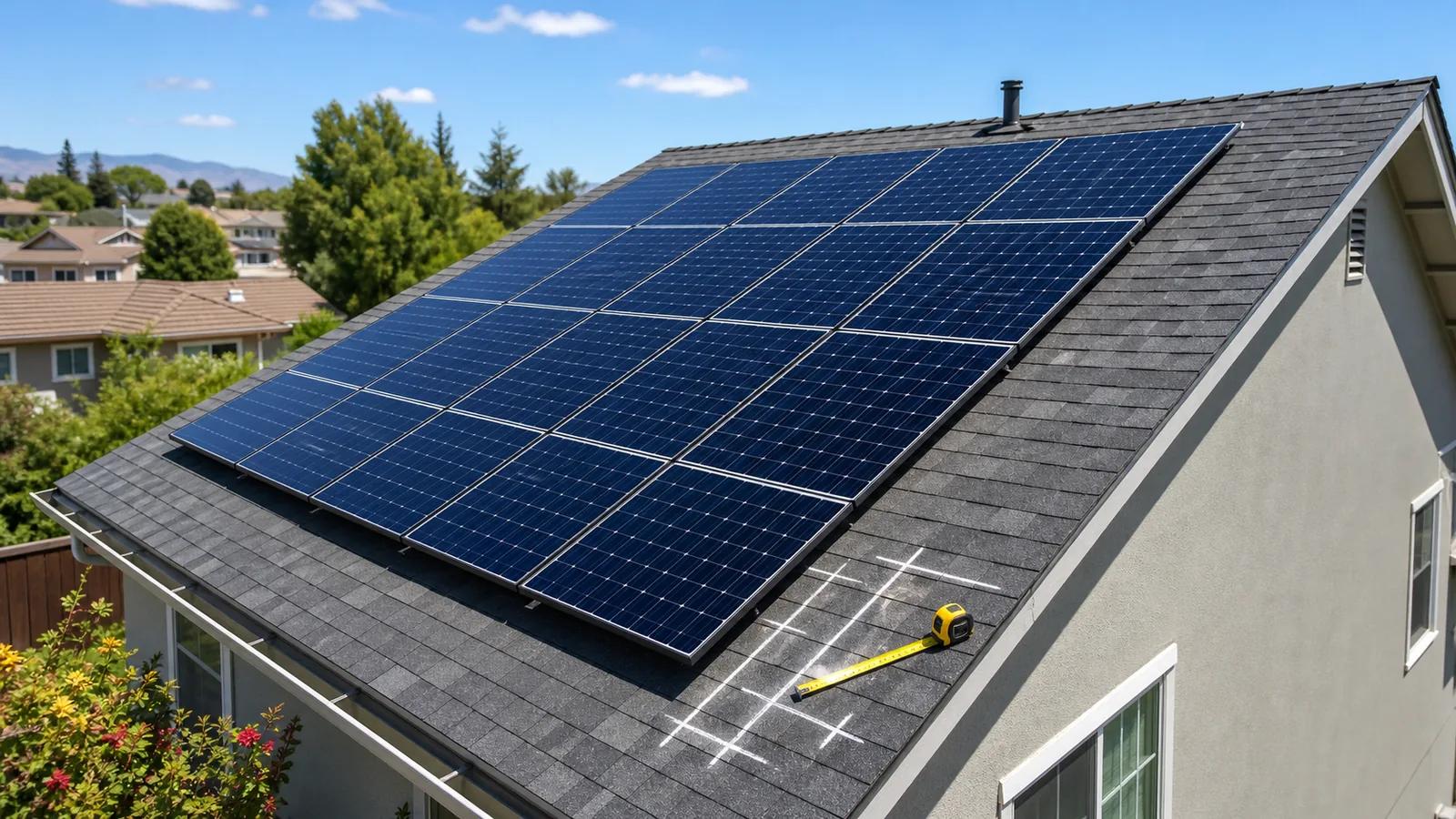
Once you have a rough system size, check whether it fits the roof in a sensible way. A panel count that looks right on paper can fail if the best roof plane is too small, shaded, interrupted by vents, or facing a less useful direction.
Use a planning formula
A simple early estimate is annual kWh divided by expected annual kWh per kW of solar. If a home uses 10,000 kWh per year and local conditions produce about 1,400 kWh per kW, the first-pass system size is about 7.1 kW before final design adjustments.
- Higher-wattage panels reduce panel count but do not remove roof constraints.
- Shade and roof direction can matter more than squeezing in one extra panel.
- Future EV or heat pump loads should be modeled separately from current use.
- Utility export rules can make a smaller system more sensible than full offset.
After the rough math, use the Panel Estimator to compare panel wattage, loss assumptions, and system size in one place.
Where to go next
For the full planning path, use the Solar System Sizing Guide as the main hub, then run the matching SolarPel calculator with your own usage, cost, and roof assumptions.
Article FAQ
Common questions
Can one formula size every home solar system?
No. A formula gives a planning estimate, but shade, roof geometry, utility rules, and equipment choices still matter.
Should I size solar for 100 percent offset?
Not always. In some utility areas, partial offset can be more economical than exporting a lot of excess energy.
Does panel wattage change panel count?
Yes. Higher-wattage panels can reduce panel count, but roof fit, cost, and availability still matter.
Written by
Firoz Ahmed
SolarPel Editorial Lead
Firoz Ahmed writes SolarPel's solar calculators, planning guides, and technical explainers with a focus on practical home-energy decisions, transparent assumptions, and source-backed solar research.