Solar Inverter Guide: String vs Microinverters vs Power Optimizers
Learn how string inverters, microinverters, and power optimizers work, their advantages and disadvantages, warranty differences, and which option may be best for your home.
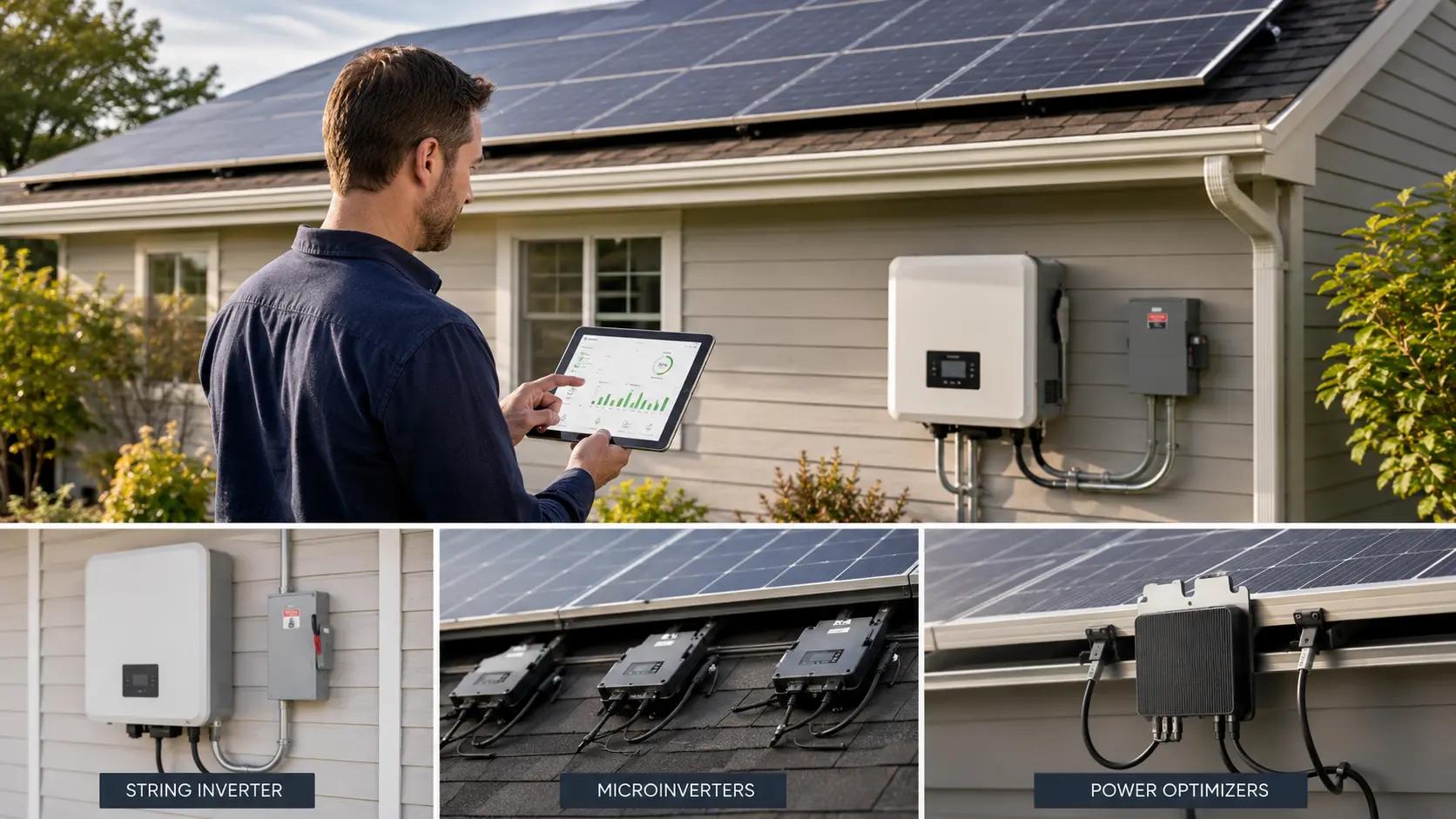
Quick answer
Choosing the right solar inverter depends on your roof layout, shading, budget, and long-term goals. String inverters are the most affordable option for simple, unshaded roofs. Microinverters maximize production on complex or shaded roofs by allowing each panel to operate independently. Power optimizers sit between the two, combining panel-level optimization with a central inverter.
If you're still planning your system, start with the Solar Panel Estimator, then review the Solar Panel Warranty Guide and How Many Solar Panels Do I Need? before comparing equipment.
What does a solar inverter do?
A solar panel produces direct current (DC) electricity, but your home uses alternating current (AC). A solar inverter converts the electricity generated by your panels into usable household power while monitoring system performance and protecting the electrical system.
Modern inverters also provide:
- Energy production monitoring
- Safety shutdown features
- Grid synchronization
- Fault detection
- Performance reporting
Without an inverter, a residential solar system cannot deliver usable electricity to your home.
The three main types of solar inverters
Residential solar systems typically use one of three inverter architectures.
String inverters
A string inverter connects multiple solar panels together into one electrical string. All panels in the string feed power into a single inverter.
Best for
- Large, open roofs
- South-facing arrays
- Homes with little or no shading
- Budget-conscious installations
Advantages
- Lowest equipment cost
- Simple installation
- Proven technology
- Easy maintenance
Limitations
- One shaded panel can reduce production for the entire string.
- Less flexible for complicated roof layouts.
- Limited panel-level monitoring.
Microinverters
A microinverter is installed beneath each individual solar panel. Every panel converts electricity independently before sending AC power to the home.
Best for
- Multiple roof orientations
- Partial shading
- Complex roof designs
- Homeowners wanting detailed monitoring
Advantages
- Excellent shade performance
- Panel-level monitoring
- Higher energy harvest on difficult roofs
- Easier future expansion
Limitations
- Higher upfront cost
- More electronic components on the roof
- Replacement may require roof access
Power optimizers
Power optimizers combine panel-level optimization with a central string inverter. Each panel is optimized individually before electricity reaches the inverter.
Best for
- Moderate shading
- Mixed roof layouts
- Homeowners seeking a balance between cost and performance
Advantages
- Better shade tolerance than standard string systems
- Panel-level monitoring
- Lower cost than many microinverter systems
- Improved flexibility
Limitations
- Still depends on one central inverter
- Slightly more complex installation
- Two types of equipment require maintenance
Native Table
| Feature | String Inverter | Microinverter | Power Optimizer |
|---|---|---|---|
| Panel-Level Monitoring | No | Yes | Yes |
| Shade Performance | Lower | Excellent | Very Good |
| Initial Cost | Lowest | Highest | Mid-Range |
| Expansion | Limited | Excellent | Good |
| Typical Warranty | 10–15 years | 20–25 years | Optimizers 20–25 years, inverter varies |
How shading changes inverter performance
Shade affects every solar system differently.
With a traditional string inverter, one heavily shaded panel can reduce production across the entire string.
Microinverters isolate each panel, allowing unaffected panels to continue producing electricity normally.
Power optimizers reduce many shading losses by optimizing each panel individually before sending power to the central inverter.
If your roof has chimneys, trees, dormers, or multiple roof angles, inverter choice becomes more important than many homeowners realize.
Warranty differences homeowners should understand
Not all warranties cover the same components.
A typical residential system may include:
- Product warranty
- Performance warranty
- Workmanship warranty
- Inverter warranty
Most string inverters include warranties between 10 and 15 years, while many microinverter and optimizer manufacturers offer warranties of 20 to 25 years.
Before signing a proposal, review the Solar Panel Warranty Guide to understand exactly what is covered.
Questions to ask your installer
Before choosing an inverter, ask:
- Why was this inverter selected for my roof?
- How will shading affect production?
- Can I monitor each panel individually?
- What happens if one inverter fails?
- What warranty covers replacement?
- Can I easily expand the system later?
- Which manufacturer provides technical support?
These questions often reveal whether an installer selected equipment based on your roof or simply their preferred inventory.
Common mistakes homeowners make
Avoid these common mistakes:
- Choosing the cheapest inverter without considering roof conditions.
- Ignoring shade from nearby trees or neighboring buildings.
- Comparing warranties without reading the coverage details.
- Assuming every panel performs independently.
- Focusing only on equipment cost instead of lifetime energy production.
- Forgetting future system expansion plans.
What should you choose?
There is no universally "best" solar inverter.
In general:
- Choose string inverters for simple, unshaded roofs where minimizing upfront cost is the priority.
- Choose microinverters for roofs with shading, multiple orientations, or homeowners wanting maximum monitoring.
- Choose power optimizers when you want improved panel-level performance without the full cost of microinverters.
The best choice depends on your roof, budget, expected production, and long-term plans rather than one technology being superior for every home.
What to calculate next
Once you've selected an inverter type, the next step is estimating the size of your solar system and expected production.
Start with the Solar Panel Estimator to estimate panel count and system size. Then continue with:
- How Many Solar Panels Do I Need?
- Solar Panel Warranty Guide
- Solar Battery Sizing Guide
- Solar Quote Red Flags
After reviewing your equipment options, use the Solar ROI Calculator to estimate long-term savings and payback.
Evidence
Sources and methodology
Prepared using manufacturer documentation, industry best practices, and SolarPel editorial standards. The guide compares inverter architectures objectively without promoting specific brands.
scenario comparison
Explains how each inverter type performs under different roof layouts, shading conditions, maintenance needs, and homeowner goals instead of recommending a single technology.
Article FAQ
Common questions
Which solar inverter is best for my home?
There is no single best inverter for every home. The right choice depends on your roof layout, shading, budget, monitoring preferences, and future expansion plans. String inverters work well for simple, unshaded roofs, while microinverters and power optimizers generally perform better on roofs with multiple orientations or partial shading.
Are microinverters worth the extra cost?
They can be. Microinverters allow each solar panel to operate independently, reducing the impact of shading and improving panel-level monitoring. For homes with complex roof designs or intermittent shade, the additional upfront cost may be justified by improved energy production and easier system monitoring.
What are power optimizers used for?
Power optimizers improve the performance of individual solar panels before sending electricity to a central inverter. They are commonly used on roofs with partial shading or multiple roof angles where a traditional string inverter may lose efficiency.
Does shading affect every inverter the same way?
No. String inverters are generally the most affected because multiple panels share one inverter. Microinverters isolate each panel, while power optimizers reduce many shading losses by optimizing production at the panel level before power reaches the inverter.
How long do residential solar inverters last?
Most residential string inverters carry warranties of approximately 10–15 years, while many microinverters and power optimizers include warranties of 20–25 years. Actual service life depends on installation quality, environmental conditions, and manufacturer specifications.
Written by
Firoz Ahmed
SolarPel Editorial Lead
Firoz Ahmed writes SolarPel's solar calculators, planning guides, and technical explainers with a focus on practical home-energy decisions, transparent assumptions, and source-backed solar research.