How Many Solar Panels Do I Need?
Estimate how many solar panels your home may need using monthly kWh, local sun, system losses, panel wattage, and roof fit.
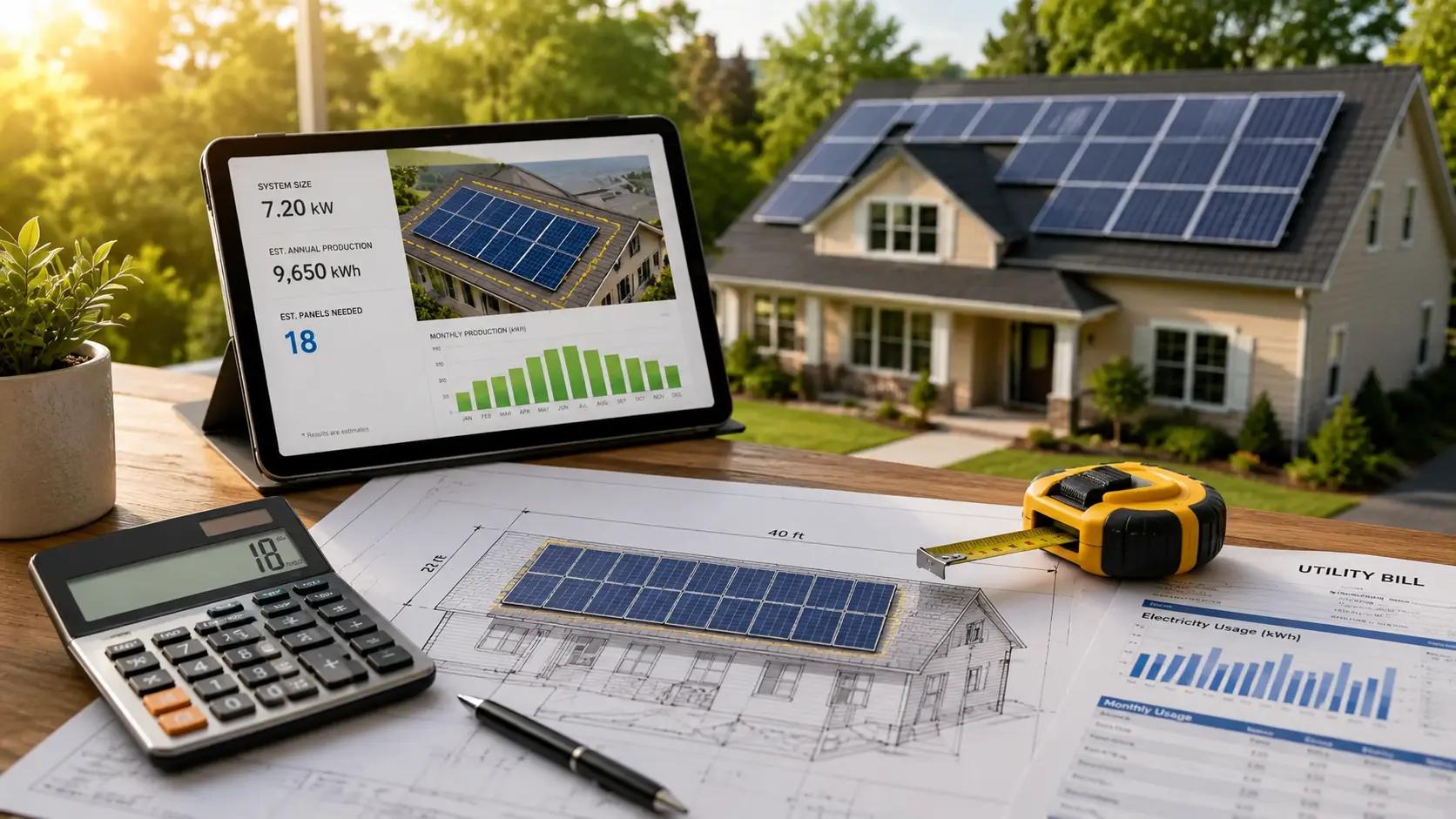
Quick answer
The number of solar panels a home needs depends on electricity use, local sun, roof fit, system losses, and panel wattage. Home size alone is not enough to size a system.
Start with your monthly kWh from the utility bill. Then use the Panel Estimator to turn that usage into a rough panel count before comparing quotes.
The kWh-first formula
A useful early sizing estimate starts with annual electricity use:
- Annual kWh = average monthly kWh x 12.
- Estimated system kW = annual kWh / expected annual production per kW in your area.
- Estimated panel count = system watts / panel watts.
That estimate should be adjusted for roof direction, shading, inverter losses, panel degradation, and whether you want to offset all or only part of your bill.
| Monthly kWh | Annual kWh | Planning array kW | Approx. panels @ 400W |
|---|---|---|---|
| 500 | 6,000 | 3.8 to 4.8 | 10 to 12 |
| 1,000 | 12,000 | 7.5 to 9.5 | 19 to 24 |
| 1,500 | 18,000 | 11.3 to 14.1 | 29 to 36 |
| 2,000 | 24,000 | 15.0 to 18.8 | 38 to 47 |
Why square footage can mislead you
Two homes with the same square footage can use very different amounts of electricity. Air conditioning, electric heating, pool pumps, EV charging, appliances, insulation, and occupant behavior can move the answer more than the size of the house.
- Use home size only as a rough conversation starter.
- Use utility-bill kWh for actual sizing.
- Use future loads, such as EV charging or heat pumps, as a separate adjustment.
What changes panel count
- Panel wattage: higher-watt panels can reduce panel count, but they do not remove roof-fit constraints.
- Peak sun and climate: sunnier locations generally need fewer panels for the same annual kWh.
- Shade: trees, chimneys, dormers, and nearby buildings can reduce useful production.
- Roof space: vents, setbacks, fire paths, and roof shape can limit layout.
- System losses: inverters, wiring, heat, soiling, and mismatch reduce delivered energy.
What to calculate next
After you estimate panel count, compare cost and savings with the Solar ROI Calculator. If the estimate looks too large for your roof, review the Solar System Sizing Guide and the Solar Panels Guide.
Evidence
Sources and methodology
SolarPel panel-count guidance starts with utility-bill kWh, then adjusts for peak sun hours, system losses, roof fit, and panel wattage. It is planning guidance only and does not replace an installer site survey or electrical design.
formula
A kWh-first panel-count formula that starts with electricity use instead of home size.
mistake warning
Explains why square footage can mislead solar sizing and why future loads should be handled separately.
calculator example
Routes readers from panel count to the Panel Estimator and Solar ROI Calculator.
Article FAQ
Common questions
How many solar panels does an average house need?
There is no reliable average without knowing annual kWh, local sun, roof fit, panel wattage, and system losses. Use utility-bill kWh before using home size.
Can I size solar from square footage?
Square footage is too rough for final sizing because two homes of the same size can use very different electricity. Monthly kWh is the better starting point.
Do higher-watt panels mean I need fewer panels?
Usually yes, but roof layout, panel dimensions, shade, inverter design, and local code setbacks still affect the final count.
Should I offset 100% of my electricity use?
Not always. Export-credit rules, roof limits, future loads, and utility rate design can make a partial offset more practical.
Written by
Firoz Ahmed
SolarPel Editorial Lead
Firoz Ahmed writes SolarPel's solar calculators, planning guides, and technical explainers with a focus on practical home-energy decisions, transparent assumptions, and source-backed solar research.