Solar Battery vs Generator: Which Backup Option Fits?
Compare solar batteries and generators by outage runtime, fuel, maintenance, noise, automatic backup, solar recharge, and cost tradeoffs.
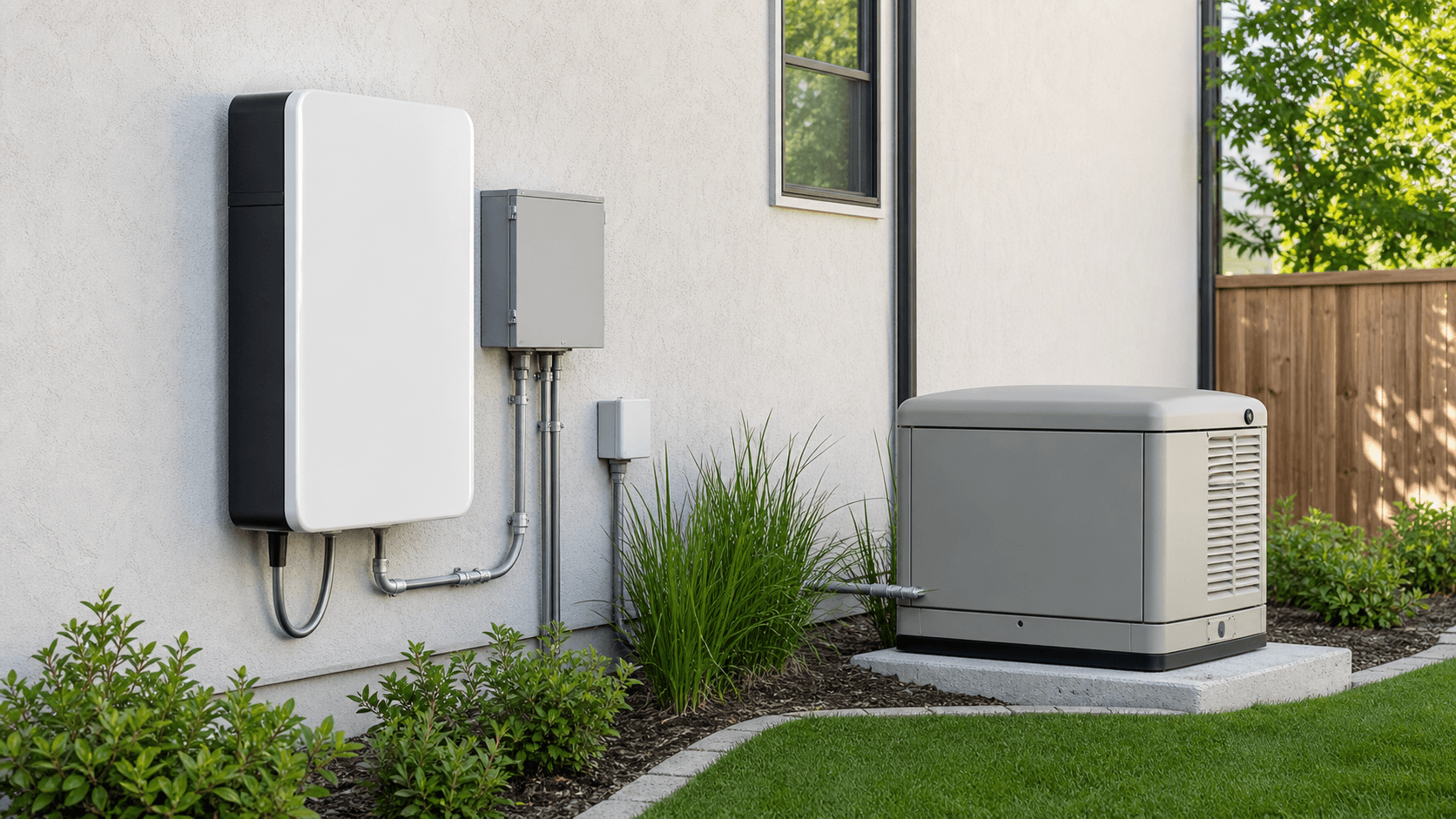
Quick verdict
Solar batteries and generators solve different outage problems. Batteries are quieter, automatic, and easier to pair with solar for short-to-medium backup windows. Generators can be better for very long outages when refueling is practical and noise or maintenance is acceptable.
The better choice depends on your critical loads, outage length, fuel access, noise tolerance, maintenance comfort, and whether rooftop solar is part of the plan.
Before comparing products, list your must-run loads and test them in the Battery Sizer. Then compare the result with the backup planning guidance in the Critical Loads Battery Guide.
Solar battery vs generator at a glance
| Factor | Solar battery | Generator |
|---|---|---|
| Best use case | Quiet backup for selected loads and solar integration | Longer outages when fuel is available |
| Fuel | Stored electricity, often recharged by solar | Gasoline, propane, diesel, or natural gas depending on model |
| Noise | Usually quiet during operation | Engine noise and placement requirements |
| Maintenance | Generally lower routine maintenance | Requires testing, fuel planning, and engine service |
| Runtime limit | Battery capacity, load size, and solar recharge | Fuel supply, safe operation, and service limits |
How the two backup options differ
A battery stores electricity and delivers it through an inverter. A generator creates electricity on demand from fuel. That basic difference changes maintenance, runtime, noise, emissions, installation constraints, and how the system behaves during repeated outages.
A battery is usually better when the goal is automatic backup for a carefully chosen set of circuits. A generator may be better when the goal is longer runtime for larger loads, assuming fuel can be stored or supplied safely.
Runtime and refueling
Batteries are limited by usable stored energy and solar recharge conditions. Generators are limited by fuel supply, refueling logistics, safe placement, and service intervals.
- Batteries are simpler for short outages and overnight critical-load backup.
- Generators can cover longer outages if fuel is available and operation is safe.
- Solar recharge can extend battery usefulness during multi-day events, but weather and load management still matter.
- Whole-home backup usually changes the economics and design for both options.
Noise, maintenance, and daily living tradeoffs
Batteries are usually quiet and low-maintenance after installation. Generators add engine noise, fuel storage concerns, periodic testing, outdoor placement constraints, and exhaust safety considerations.
Homeowners often underestimate the day-to-day maintenance side of a generator decision and overestimate how often they truly need whole-home backup. A critical-load list keeps the comparison practical.
Critical loads matter more than headline capacity
The better comparison starts with critical loads, not product marketing. If your goal is refrigeration, internet, lights, phone charging, and a few outlets, a battery-based plan may be enough.
If your goal is long runtime for larger loads, repeated multi-day outages, well pumps, large HVAC equipment, or whole-home coverage, the economics and design can shift toward generator or hybrid planning.
Use the Solar Batteries Guide and Solar Battery Buying Guide to separate backup goals from storage marketing claims.
When a solar battery is the stronger fit
- You want quiet, automatic backup for selected circuits.
- You already have or plan to add rooftop solar.
- Your outages are usually short or moderate.
- You want to reduce fuel handling and routine engine maintenance.
- Time-of-use rates or weak export credits make stored solar more useful.
When a generator may be the stronger fit
- Your outages are often long and fuel supply is dependable.
- You need sustained power for larger loads.
- You are comfortable with noise, testing, placement, and maintenance.
- You want backup independent of solar production and battery recharge conditions.
- Local rules and site layout allow safe generator operation.
Hybrid battery plus generator planning
Some households may prefer a hybrid strategy: a battery for automatic short outage coverage and a generator for longer events. That adds cost and coordination complexity, but it can match real outage patterns better than forcing one tool to solve every scenario.
Hybrid planning should be reviewed carefully because transfer equipment, load panels, inverter settings, generator behavior, and local code all matter.
What to calculate next
Start with the Battery Sizer and enter only the loads you truly need during an outage. If the battery result looks too large or expensive, compare it with a generator or hybrid backup design before changing your solar quote.
If you are also deciding whether storage is necessary at all, read Solar Panels Without a Battery before treating battery backup as a default requirement.
Bottom line
Choose a battery when quiet operation, automatic switching, critical-load backup, and solar integration matter most. Choose a generator when long outages and higher sustained loads matter more than simplicity and noise. Compare both against a real critical-load list before deciding.
Evidence
Sources and methodology
SolarPel compares batteries and generators by planning criteria rather than brand claims: critical-load scope, outage duration, fuel/recharge limits, maintenance, noise, and installation constraints.
decision table
Compares solar batteries and generators across fuel, runtime, maintenance, noise, and best-fit scenarios.
mistake warning
Warns readers not to compare backup options by headline capacity without a critical-load list.
calculator example
Routes homeowners into the Battery Sizer before comparing backup products.
Article FAQ
Common questions
Is a solar battery better than a generator?
It depends on the outage pattern and backup goal. Batteries are often better for quiet short-term backup, while generators can be more practical for long outages when fuel is available.
Can a solar battery replace a generator?
Sometimes, especially for modest critical-load backup. It may not replace a generator when very large loads, long outage duration, or whole-home backup are required.
Can solar recharge a battery during outages?
In many backup-capable designs, yes. Actual recharge depends on weather, array size, inverter setup, battery settings, and how much electricity the home is using during the outage.
Is a generator cheaper than a solar battery?
A generator may have a lower upfront equipment cost, but total cost depends on installation, fuel, maintenance, runtime needs, electrical work, and local safety requirements.
Written by
Firoz Ahmed
SolarPel Editorial Lead
Firoz Ahmed writes SolarPel's solar calculators, planning guides, and technical explainers with a focus on practical home-energy decisions, transparent assumptions, and source-backed solar research.