How to Size a Battery for Critical Loads
Estimate battery size for critical home loads by listing watts, runtime, backup days, depth of discharge, and reserve margin.
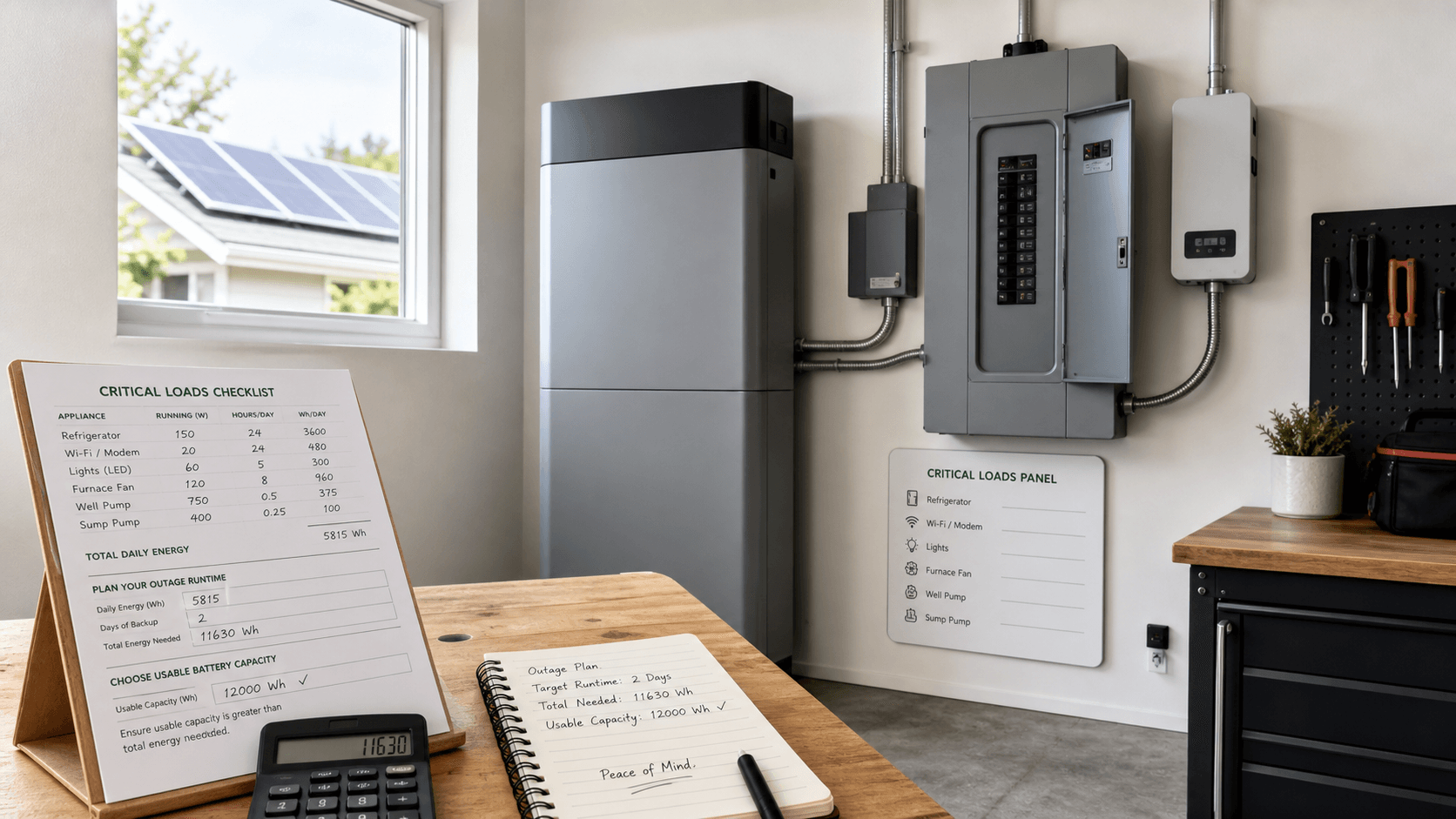
Quick answer
To size a battery for critical loads, list only the circuits you truly need during an outage, estimate each load's wattage and runtime, convert that into kWh, then adjust for usable capacity, inverter efficiency, backup days, and reserve margin.
Do not start with whole-home backup unless you know the cost and equipment implications. Critical-load planning is usually cleaner because it separates essential circuits from comfort loads.
Use the Battery Sizer after you list your actual loads.
What counts as a critical load?
Critical loads are the appliances and circuits you want to keep running when the grid is down. For many homeowners, that means refrigeration, basic lighting, internet, phone charging, medical devices, selected outlets, and sometimes a furnace fan or well pump.
- refrigerator or freezer
- internet modem and router
- selected lights
- phone and laptop charging
- furnace fan
- sump pump or well pump
- medical equipment
Runtime formula
The simple planning formula is:
Load watts x hours of runtime = watt-hours.
Then divide watt-hours by 1,000 to convert the estimate into kWh.
After that, adjust for usable battery capacity and reserve margin: required battery kWh = daily critical-load kWh x backup days / usable capacity factor.
If your critical loads need 5 kWh per day, you want 2 backup days, and you assume 85 percent usable capacity, the planning estimate is 5 x 2 / 0.85, or about 11.8 kWh of battery capacity.
Example critical-load worksheet
| Load | Example watts | Runtime | Daily energy |
|---|---|---|---|
| Refrigerator | 150 W | 10 hours | 1.5 kWh |
| Internet equipment | 25 W | 24 hours | 0.6 kWh |
| LED lights | 80 W | 5 hours | 0.4 kWh |
| Furnace fan | 400 W | 3 hours | 1.2 kWh |
| Device charging | 100 W | 3 hours | 0.3 kWh |
What not to include without installer review
Some loads can start suddenly, pull high surge power, or require dedicated wiring. A battery may have enough energy capacity but still lack the power output needed to start or run a specific appliance.
- well pumps
- central air conditioning
- electric water heaters
- induction ranges
- electric dryers
- large workshop tools
- whole-home heating loads
Battery capacity vs power output
Battery capacity tells you how much energy is stored. Power output tells you how much load the battery can run at one time.
Do not confuse the two. A battery might have enough kWh for several hours, but it still may not be able to start a pump or run many loads at once.
Add reserve margin
Reserve margin gives you breathing room for weather, aging, extra runtime, and loads that use more power than expected. A practical planning range is often 15 to 25 percent reserve, but the right number depends on the risk you are trying to cover.
For broader storage planning, compare this page with the Solar Battery Sizing Guide, the Solar Batteries Guide, and the Solar Battery Buying Guide.
Bottom line
The right battery size starts with a critical-load list, not a battery brochure. Decide which circuits matter, estimate their runtime, adjust for usable capacity, and then use the Battery Sizer to compare realistic backup scenarios.
Evidence
Sources and methodology
SolarPel critical-load sizing uses simple watt-hour planning math and separates energy capacity from power output. It avoids product-specific claims unless manufacturer documentation is available.
calculator example
Shows the watt-hour and usable-capacity calculation behind a critical-load battery estimate.
decision table
Provides a critical-load worksheet that separates load watts, runtime, and daily energy.
mistake warning
Warns readers not to confuse battery capacity with power output or assume large loads without installer review.
Article FAQ
Common questions
What are critical loads?
Critical loads are the circuits or appliances you want to keep running during an outage, such as refrigeration, basic lights, internet, medical equipment, and selected outlets.
Can a battery run a well pump?
Sometimes, but it depends on the pump's power and startup surge. Well pumps should be reviewed with an installer before being added to a backup plan.
How much reserve margin should I use?
A reserve margin around 15 to 25 percent is a useful planning range, but critical homes, medical needs, and longer outage goals may need more.
Written by
Firoz Ahmed
SolarPel Editorial Lead
Firoz Ahmed writes SolarPel's solar calculators, planning guides, and technical explainers with a focus on practical home-energy decisions, transparent assumptions, and source-backed solar research.