Net Metering vs Net Billing: What's the Difference for Solar Homeowners?
Learn the difference between net metering and net billing, how each program credits exported solar electricity, and what the policy means for your solar savings, battery value, and long-term payback.
Quick answer
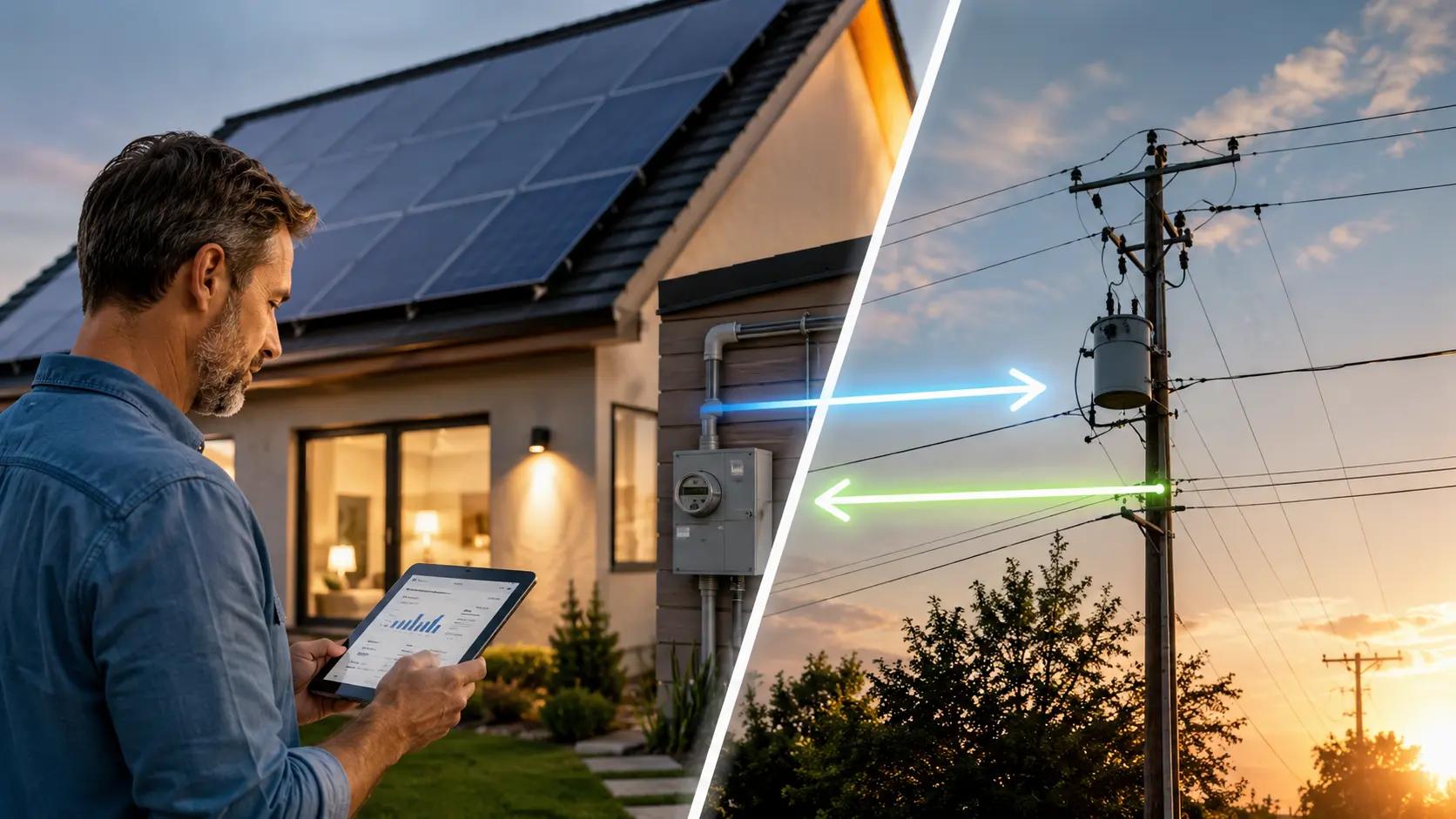
Net metering and net billing both allow homeowners to receive credit for excess solar electricity exported to the utility grid. The difference is how that exported electricity is valued.
With net metering, exported electricity is typically credited at or near the retail electricity rate. With net billing, exported electricity is usually credited at a lower utility-defined rate.
Before comparing solar quotes, confirm which export policy your utility uses, then estimate how it affects your long-term savings with the Solar ROI Calculator
Why the difference matters
Your solar panels may produce more electricity than your home needs during sunny hours. Instead of wasting that electricity, it can be exported back to the utility grid.
The value your utility assigns to those exported kilowatt-hours directly affects:
- Annual electricity savings
- Solar payback period
- Lifetime system value
- Battery storage benefits
- Overall return on investment
Two homeowners with identical solar systems can see different financial results simply because their utility uses a different export compensation program.
How net metering works
Traditional net metering allows homeowners to offset electricity purchased from the grid with electricity exported from their solar system.
When your solar panels generate more electricity than your home needs, the excess flows to the utility. Those exported kilowatt-hours are typically credited at or close to the retail electricity rate and can offset future electricity usage.
Benefits of net metering
- Higher export value
- Faster solar payback
- Easier bill calculations
- Better long-term savings
- Less concern about daytime energy use
Many homeowners find traditional net metering easier to understand because exported electricity directly offsets future electricity purchases.
How net billing works
Net billing separates the value of electricity you purchase from the value of electricity you export.
Instead of receiving retail-rate credits, exported solar electricity is usually credited at a lower rate determined by your utility. Because exported energy is worth less, using more of your own solar electricity becomes increasingly important.
Common characteristics of net belling
- Credit exports at lower rates
- Encourage more self-consumption
- Increase the value of battery storage
- Require homeowners to pay closer attention to electricity usage patterns
The exact export rate varies by utility, so homeowners should always review current utility policies before making financial decisions.
Key differences homeowners should compare
When reviewing utility policies or solar proposals, compare the following:
Export credit value
Net metering generally credits exported electricity at or near the retail electricity rate.
Net billing typically credits exported electricity using a lower export rate established by the utility.
Battery value
Under traditional net metering, batteries are often installed primarily for backup power.
Under net billing, batteries may provide additional financial value by storing excess solar electricity instead of exporting it at a lower credit rate.
Long-term savings
Export compensation affects the overall financial return of a solar system.
Higher export credits can shorten the payback period, while lower export credits place greater importance on using solar electricity directly within the home.
How battery storage changes the equation
Battery storage allows homeowners to store excess solar electricity for later use instead of exporting it immediately.
This can become especially valuable under net billing programs because stored electricity may offset expensive evening electricity purchases.
A battery may help you:
- Increase self-consumption
- Reduce electricity purchases
- Improve backup power
- Reduce reliance on lower export credits
Whether battery storage makes financial sense depends on electricity prices, battery cost, utility policies, and your household's energy usage.
For battery planning, see the Solar Battery Sizing Guide and the Battery Sizer Calculator .
Questions to ask your utility or installer
Before signing a proposal, ask:
- Does my utility offer net metering or net billing?
- How is exported electricity credited?
- Can export rates change in the future?
- Are credits applied monthly or annually?
- Does battery storage improve savings under this program?
- Are there additional fees or minimum monthly charges?
Clear answers to these questions make it easier to compare competing solar proposals.
Common mistakes homeowners make
Many homeowners assume every utility credits exported solar electricity the same way.
Avoid these common mistakes:
- Assuming all export credits equal the retail electricity rate
- Comparing quotes without understanding utility policies
- Ignoring future policy changes
- Purchasing batteries without evaluating actual savings
- Focusing only on system price instead of long-term value
Understanding your utility's compensation program helps you make a more informed investment decision.
What to calculate next
After identifying whether your utility uses net metering or net billing:
- Estimate your projected savings with the Solar ROI Calculator.
- Compare total project costs in the Solar Cost Guide.
- Understand your break-even timeline in the Solar Payback Guide.
- Review the Net Metering Guide for a deeper explanation of utility credit programs.
Looking at these resources together provides a more complete picture of your potential solar investment.
Evidence
Sources and methodology
Prepared according to SolarPel Editorial Guidelines using publicly available utility policy concepts and homeowner educational resources. The guide compares export compensation models conceptually without providing state-specific legal or regulatory advice. Readers should confirm current policies directly with their electric utility before making purchasing decisions.
methodology
This guide explains the practical differences between net metering and net billing without assuming a single utility policy applies everywhere. It helps homeowners understand how export compensation affects long-term solar savings rather than promoting one program over another.
calculator example
Readers are encouraged to compare export policies first, then estimate how those policies affect long-term savings using the Solar ROI Calculator, rather than relying on generic savings estimates.
Article FAQ
Common questions
Which is better: net metering or net billing?
Neither program is universally better. Traditional net metering often provides higher export credits, while net billing usually credits exported electricity at a lower rate. The better option depends on your utility's rules, electricity rates, and how much solar energy your home uses during the day.
Does net billing make solar less worthwhile?
Not necessarily. Solar can still reduce electricity costs under net billing because you save the most by using your own solar energy first. The financial impact depends on export credit rates, electricity prices, system size, and your household's energy usage.
Should I install a battery with net billing?
A battery may provide greater value under net billing because it allows you to store excess solar electricity instead of exporting it at a lower credit rate. Whether the investment makes sense depends on battery cost, electricity prices, and your backup power goals.
Can utilities change from net metering to net billing?
Yes. Some utilities and state regulators have replaced traditional net metering with net billing or other export compensation programs. Always verify the current policy with your utility before purchasing a solar system.
Written by
Firoz Ahmed
SolarPel Editorial Lead
Firoz Ahmed writes SolarPel's solar calculators, planning guides, and technical explainers with a focus on practical home-energy decisions, transparent assumptions, and source-backed solar research.